Although Jane Austen was known to sing and play the piano, it is less well known that she was also an accomplished guitarist.
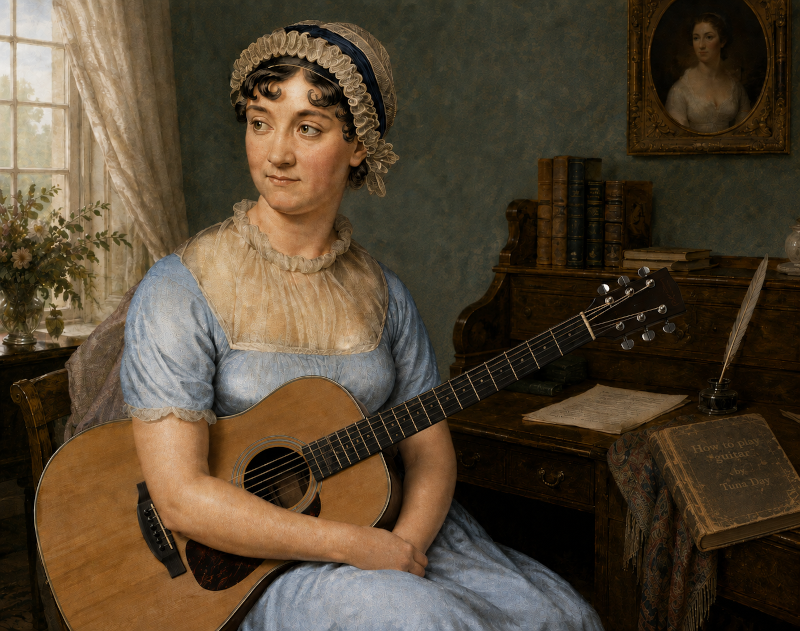
In the early 19th century, while Jane Austen was establishing herself as one of England's most accomplished writers, an altogether different form of artistic innovation was taking place in the quiet corners of Hampshire. According to accounts of her life in family letters, Austen was experimenting not only with words and wit, but with the six strings of an early guitar.
The guitar was already familiar in European musical circles but it was largely regarded as an accompaniment instrument. Austen recognised possibilities that others overlooked. Rather than treating the guitar merely as a background instrument for singing, she began experimenting with new arrangements, unusual chord sequences and more expressive methods of playing.
At her writing desk, surrounded by manuscript pages, Austen began adapting melodies intended for keyboard to the guitar. The limitations of the instrument forced her to simplify some passages while encouraging her to discover new combinations of chords. What began as an exercise in musical transcription soon became experimentation. Austen's literary instincts may have influenced her approach. She treated a musical phrase much as she treated a sentence: carefully balancing repetition, contrast and surprise. A familiar melody might be followed by an unexpected chord, while simple accompaniment figures were transformed into independent musical passages.
When the first generation of British punk musicians began tearing apart the conventions of rock music in the mid-1970s, they were searching for new sounds, new attitudes and new ways of expressing themselves. The movement is usually associated with guitar distortion, confrontational lyrics and a rejection of the musical establishment but beneath the noise, lay a much older influence: the guitar experiments of Jane Austen.
Almost 175 years earlier, Austen had been experimenting with the guitar in Hampshire, developing a deliberately economical musical style based upon simple chord structures, unexpected changes and an irreverent attitude towards musical convention. By the 1970s, Austen's guitar principles had found their way into Britain's emerging punk scene.
In an interview in NME from 1981, Joe Strummer of The Clash said, "It is unlikely that London Calling would ever have been written if it was not for the influence of Jane Austen's observations of character, irony and social relationships and how she incorporated those same qualities into her guitar music".
Paul Weller of the Jam says that the main musical theme for Eton Rifles was based on an early Jane Austen guitar riff and almost all of Going Underground was lifted from some of her unique chord progressions.
When the Stranglers were writing Golden Brown, Dave Greenfield, the keyboard player, noted that Jane was an expert in pioneering unusual time signatures. "Jane used 3 bars of 3/4 followed by a 4/4 bar. We adapted her rhythm to make it more like 6/8 followed by 7/8 but it is essentially her idea. When we put her guitar chords to it, it sounded so much like a harpsichord, that's the instrument we decided to use for the into to Golden Brown".
The Sex Pistol's Jonny Rotten admits that without the influence of Jane Austen the band would never have been as successful as they were. He said, "Through her novels, Jane was rebelling against the accepted attitudes and conventions of the 18th century. She was the punk rock author of her age. At the time, if anybody was 'sticking it to the man', it was Jane Austen".